


Golden Age: Kullamae on Čanak’s coaching, his return to Lietkabelis, medal hopes
The 2022/2023 season was the first time Kristian Kullamae played for Lietkabelis. He averaged 13 points throughout the year and became one of the leaders right from the start.
After one season spent in Panevėžys, he signed with Bilbao Surne Basket, where he also proved to be a very talented young player. However, in the second year playing for the Spanish club, the player was slowed down by the first serious injury in his career, and his point total decreased significantly.
Then he received a call from Lietkabelis and didn’t hesitate to accept their offer because he already knew this organization well. Now he is playing his best season in LKL, sponsored by Betsson, and is aiming to win a medal.
LKL academy powered by Citadele presents an interview with Kullamae about his time in Spain, Lietkabelis organization, long-term connections in Panevėžys, and his role on the team.
Before joining Lietkabelis for the first time, you played for a Spanish club called Burgos CB Miraflores, where you didn’t have a particularly good season. Could you have imagined that you would get a call from a EuroCup team’s coach? Was it a big surprise?
Yeah, it was a tough year for me in Spain. I was trying to find a place where I could showcase myself at a higher level, and I was lucky to get a call from Lietkabelis. Also, I think that over the years, the Estonian men’s national basketball team helped me a lot to get this opportunity. In my opinion, everything happens for a reason, and I was really grateful that Nenad Čanak and Lietkabelis wanted me on the team.
After joining Lietkabelis, you became one of the leaders right from the start and averaged 13 points throughout the season. What helped you to adapt so quickly?
The thing that helped me was just being at a higher level. Not everyone gets a chance to be a part of the Spanish league’s team, and I was definitely lucky to be there. But I wasn’t surprised that I could play this way for Lietkabelis because it was more about the opportunity and trusting what the coach can give you. Like I said, already having experience at a high level helped me to adapt to the EuroCup and LKL, sponsored by Betsson.
The 2022/2023 season was successful for the club. You reached the EuroCup’s round of 16, won LKL, sponsored by Betsson, and Citadele KMT bronze medals. Which achievement from this season means the most to you personally and why?
I would say the EuroCup’s round of 16 means the most to me personally, as it was also my first time playing at such a high international level. Let’s say we were a bit unlucky because we didn’t make the quarterfinals. But we played against great teams and had remarkable wins both at home and away. All these small details made the season remarkable for us.
After one year in Panevėžys, you signed a one-year contract with Bilbao Surne Basket. What were the main reasons that you signed with this club? Did you want to go back to the Spanish league to prove to everyone that you are now a new and improved player?
As you said, the first time I was in Spain, I didn’t get a chance to play. I was still quite a young player. After the first year in Bilbao, I was definitely more mature, played higher-level games throughout the year, and I wanted to challenge myself in Spain once again. For these reasons, Bilbao looked like a perfect place for me, and it was a solid organization, so I didn’t really hesitate to go there. I just wanted to prove to myself that I can play against really good Spanish league teams and players.
You played for this club for two years, and I saw one of your interviews in Spanish. When did you manage to learn Spanish? Did you learn it naturally, or did you have to put in time and effort?
I had already lived in Spain for 5 years in my life, so I learned Spanish just from being there and talking with my teammates in the locker room. Of course, I learned a bit from Spanish lessons, but it was mainly because of being in this environment and getting used to the language. That’s why I was able to do some interviews in Spanish and talk with my teammates in their mother tongue.
The first season in Bilbao was very good for you; however, in the second one, your point total decreased significantly. Was it more because of the team dynamics, coaching decisions, or your own form?
I would say that a little bit of everything. It was a hard year for me because it was the first year when I got injured. For me, it was a new learning experience, and I wasn’t able to come out of it as the team, and I wanted to. However, as I said, everything happens for a reason.
After two seasons spent in Bilbao, you received a call from Nenad Čanak. Did that conversation remind you of the first one, after a season in Burgos?
Not really. I had already played for Lietkabelis and liked it here, so it made the decision easier. I was happy here and had a good relationship with everyone when I played here for the first time. Also, I wanted a good place to recover from an injury and regain my confidence. Lietkabelis plays in the EuroCup and LKL, sponsored by Betsson, which, in my eyes, is an underrated league. So, all these little details made it much easier to come back to Panevėžys.
Speaking about Lietkabelis’ coach, what are Nenad Čanak’s strongest traits that especially benefit younger players such as yourself?
I liked that he also played basketball at a high level in the past. He knows how players think and react to certain things. There were times in Spain when I felt that coaches didn’t really understand their players because they hadn’t played professional basketball. Whereas Čanak knows players really well, their personalities, and how they react to some things happening on the court. For sure, these traits help young players a lot.
Just like this year, Jamel Morris, Vytenis Lipkevičius, and Gabrielius Maldūnas were also your teammates when you first joined the Panevėžys club. Do these long-term connections help the team build stronger chemistry on and off the court?
I think it just gives more confidence and trust. Lithuanians are not only important on the court, but also in the locker room. These connections make things easier.
You're playing your best season in LKL, sponsored by Betsson, and averaging 14,77 points and 3,15 assists. Is there something you’re doing on the court this season that you weren’t even fully aware you were capable of before? Maybe you're taking on more responsibility in the team’s offense?
No, not really. I don’t force anything. I just play the way I have all my life, and work hard every day, and this is the result. I live by the saying that everything happens for a reason. The only thing that changed from the first season is my position. I played as a point guard, and now I am playing as a shooting guard. I think I can play both positions, but the club and coach have decided that I will play as a shooting guard. So, I just try to adapt and be the best version of myself.
Your three-point percentage has been extremely high throughout your career. Was your father, a legendary Estonian basketball player, the one who pushed you to develop this skill from an early age?
I shoot a lot of three-pointers and work on them every day. The percentage is a result of a lot of details, but I also think that you must have at least a bit of talent; not everything comes from hard work. Of course, my father was a really good shooter, maybe the three-point shot is in my DNA (laughs). Every time I shoot, I believe that it will go in, so I must be confident and believe in myself.
On January 18, you scored 24 points against Utena Juventus, leading Lietkabelis to the Citadele KMT Final Four. A lot of people thought that you were the underdogs of the tournament, but you still managed to win bronze medals. What do you think is the secret behind the fact that Lietkabelis competes for medals year after year, despite the challenges?
The team had quite a lot of medals throughout the last couple of years, so expectations and the responsibility are much higher for the club. We fight as one fist in every game. This mentality starts in the locker room. Also, the management personality helps to unite everyone. This feeling of trust makes it easier to fight for each other and give that extra percent, especially in games for a medal.
The regular season is coming to an end. What goals have you set for yourself and the team?
For me, the most important thing is to stay healthy, stay in shape, and be available in the last games of the season. For the club, to keep the tradition of winning medals alive and fight for every win. It won’t be easy; we will have a tough quarterfinal, so we will see what happens after that. For sure, we have no lower expectations than to win a medal.
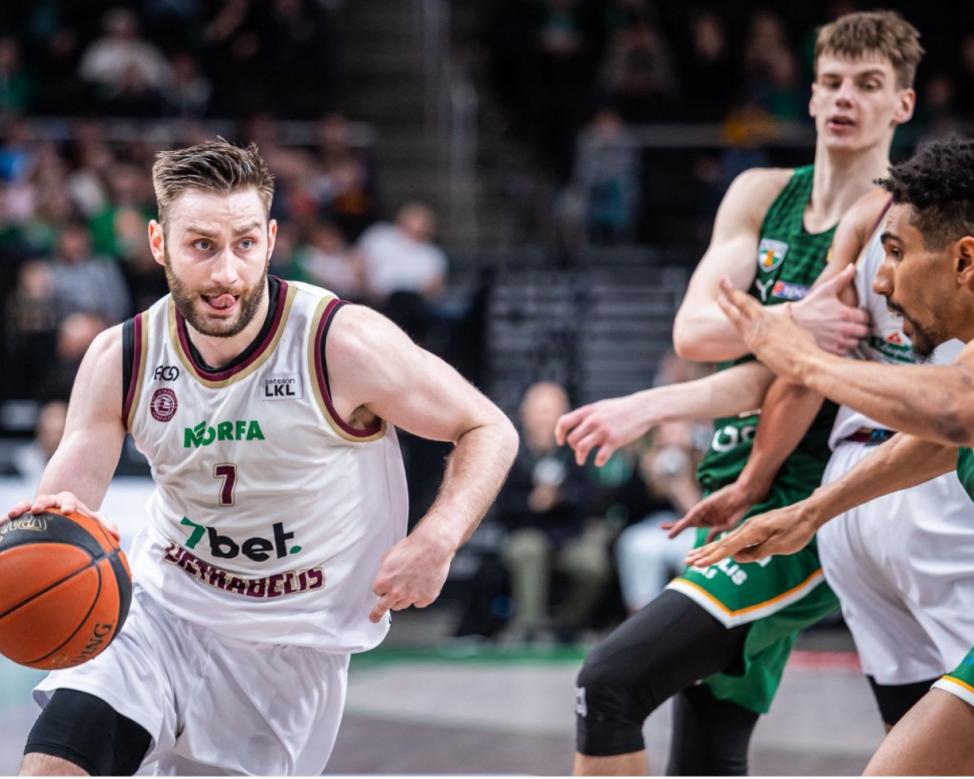
Finally, I must ask you about something that is constantly seen in your game – your tongue. You often have it sticking out while playing or after scoring a basket. Have you ever bitten your tongue during a game or practice?
What an interesting question (laughs). Nobody really has asked me this before, but no, I haven’t. I’ve had some facial injuries, but, luckily, not with my tongue. I hope it will stay this way.

Partners